
News
Report] "Science Castle World 2025" Evolves into a World Convention, Offering a Multifaceted View of the Shape of Resilience
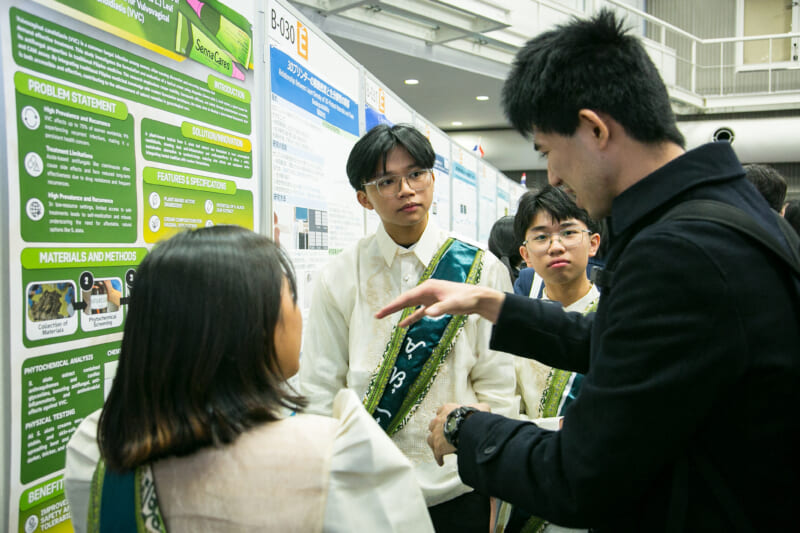
On December 13 and 14, 2025, Science Castle, the gateway to success for junior and senior high school researchers, reached a major turning point. The format that had previously been held at various chapters in Japan was merged into "Science Castle World 2025," bringing together young researchers from around the world.
Convention website:https://castle.lne.st/schedule/science-castle-world-2025/
More than 200 abstracts from all over Japan and Southeast Asian countries such as Malaysia, Singapore, the Philippines, Indonesia, and Vietnam gathered at Science Tokyo, the venue for the conference.
It should be noted that the competition became "WORLD," making visible the "different approaches of each country and region" to common issues.
For example, even in the area of "environmental conservation," knowledge of ecosystem maintenance in urban areas in Japan and mangrove regeneration technology in coastal areas of Southeast Asia were discussed in the same forum. By exchanging each other's on-the-ground wisdom, participants were able to learn about issues in other countries that they had not known before, and new ideas were born.
Here we have selected 16 abstracts related to "urban development, environment, and disaster prevention" that support our daily lives. These are studies based on the curiosity of junior and senior high school students, who have been walking around the sites on their own and steadily accumulating data.
1. urban environment/nature symbiosis type city planning
This research takes a practical view of coexistence with nature in urban areas from the perspective of "maintaining urban ecosystems," rather than mere idealism.
-
Urban environment supported by undergrowth(C-206 / Japan / Keita Arai)
-
Sustainable Wetland Ecosystem Restoration Methods in a Society with Declining Population(B-072 / Japan / Kaede Kimura)
-
Biodiversity conservation in small-scale biotope production(c-106 / japan / mouri shizuru)
Disaster prevention and resilience (disaster-resistant city planning)
How can we utilize information technology and the power of nature to cope with the frequent occurrence of natural disasters? Both the Philippines and Japan made concrete proposals for "protection" in accordance with regional characteristics.
-
LINOG: Local and National Forecasting System for Earthquake Intensity Data(C-024 / Philippines)
-
Saving Lives with the Power of Color Development of New Flood Hazard Maps(C-225 / Japan / Takanashi Shikanu)
-
MangroveMatch: GIS determination tool for mangrove regeneration areas(C-040 / Philippines)
3. preservation of water environment and local resources (creation of infrastructure for livable communities)
Studies based on years of fixed-point observations tell the "history of change" in an area. These are important evidence for maintaining the local infrastructure.
-
Water quality environment and fish fauna in the middle reaches of the Tama River focusing on domestic wastewater(B-021 / Japan / Tadamasa Kasuya)
-
Relationship between water color and phytoplankton counts in Sunpu Castle Park(C-210 / Japan / Shimomura Coral)
-
Trends of fish species in the waters around Hirakata Bay - Changes over the past 20 years(B-025 / Japan / Yoto Satsukome)
Environmental technology and recycling-oriented urban development
It is an attempt to rewrite the concept of "waste" and circulate it into "materials" for the city. The empirical approach with physical property evaluation shows the way to sustainable architecture.
-
Development of concrete using plastic waste(B-065 / Japan / Nichiyo Iino)
-
Verification of thermal insulation performance of food waste and agricultural by-products and utilization of building materials(B-070 / Japan / Shota Ueno)
-
Evaluation of thermal and acoustic insulation performance of wall materials made of natural materials(B-069 / Japan / Shogo Watanabe)
-
FROM WASTE TO WALLS: PET bottle x cigarette butt tile(C-007 / Philippines)
Urban and regional energy
It is a challenge to overcome the limitations inherent in cities and to achieve local production for local consumption of energy.
-
No-spinning, noiseless wind power generation that comes to life in urban areas.(B-077 / Japan / Karin Ichioka)
-
Wind turbine generator taking advantage of environmental conditions(c-228 / japan / mukai amber tarou)
Urban safety and infrastructure
Research on fundamental technologies to maintain a safe and clean urban environment.
-
Measures to prevent human intrusion while maintaining the wave-dissipating effect of wave-dissipating blocks(c-230 / japan / mazui sasaki)
-
AeroLog: PM monitoring technology (air quality management)(C-030 / Philippines)
The evolution to "WORLD" expanded the perspective of middle and high school students from "solving local issues close to home" to "presenting optimal local solutions to common global issues.
In this project, we will not let these findings shared across borders end as mere educational achievements. We will learn from the "voices in the field" derived by the next generation of researchers, and together we will take steps toward the implementation of a more resilient and flexible society.
▶︎ Science Castle WORLD 2025 For details (official web), click here. https://castle.lne.st/schedule/science-castle-world-2025/